The Left and The Right’s Flawed Gun Debate
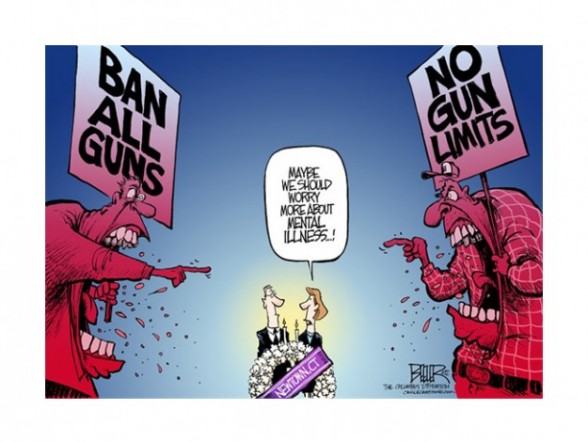
I’m Calling B.S. on the Prevailing Arguments from Both Political Wings on Guns
A common right-wing argument is that more guns and less restrictive gun laws correlate with less crime and gun violence. A common left-wing argument is that fewer guns and more restrictive gun laws correlate with less crime and gun violence. The less spoken argument is that the wider the gap between the rich and the poor correlates with more crime and violence — and conversely, the smaller the gap, the less crime and violence.
No one can prove that more gun laws will result in less violence. It is a correlation-equals-causation argument — just like arguing that fewer gun laws and more guns equals less violence. There are areas with more gun laws that have less crime, and areas with more gun laws that have more crime. Likewise, there are places with less restrictive gun laws that have high crime rates and others with lower crime rates.
The knee-jerk reaction by liberals to immediately start talking about new gun laws after every tragedy — or conservatives arguing that more guns or some expert civilian marksman being near the scene would have stopped it — is the equivalent of putting anti-itch cream on your foot because you have athlete’s foot on your privates. With the exception of the Virginia Tech shooting, most gun laws people advocate for after a tragedy would NOT have prevented that tragedy if the proposed law had been in place beforehand. So convince me: what specific gun law would have prevented the tragedy at hand, or any past tragedy?
The correlation no one talks about is the wealth gap between the rich and the poor. If you look at industrialized wealthy countries and compare them, you’ll find that the wider the gap between rich and poor, the higher the rate of crime. Yet neither side has been pushing this as a factor that creates an environment ripe for people turning to violence or crime as a means of survival. I suspect the reason neither side offers the wealth gap as a possible root cause is that it undermines both of their prevailing arguments about guns — and may expose both sides for using gun tragedies to advance their other political objectives.
Conservatives, for example, are generally hostile toward any conversation about the wealth gap between the rich and poor, dismissing such discussions as rooted in envy of the wealthy. Yet the wealth gap correlation argument could actually be used by them to refute the liberal claim that too many guns is itself the root cause of violence — making it a conflict of political interest for them to ignore it. Liberals, on the other hand, are generally anti-aggression and anti-violence, which leads them to be hostile toward guns in general. For them to champion the wealth gap correlation argument would mean admitting that guns themselves are not the root cause — also a conflict of political interest.
If you look at industrialized wealthy countries, you’ll find places like Switzerland, which has one of the highest rates of gun ownership in the world next to the United States, yet Switzerland’s homicide rate is very close to that of France — which has lower per capita gun ownership but a similarly small wealth gap.
Once we acknowledge this correlation, we can begin to properly examine it. Until then, everyone can keep putting anti-itch cream on their privates to cure that athlete’s foot problem.
Further Reading:
Wealth Gap Correlation with Violence
Comparison of the wealth gap between provinces in canada and usa