Meme Busting: Black Actresses/ Actors Last 20 years.
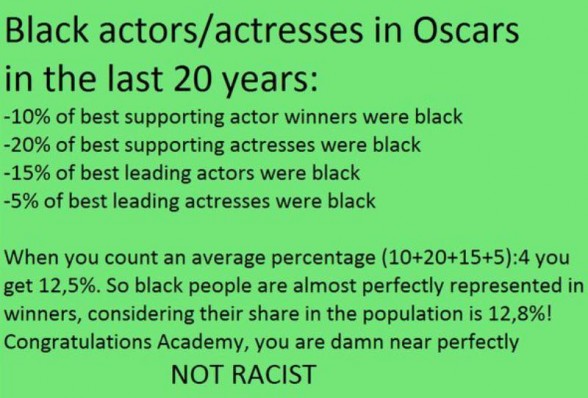
This meme is being pushed around as a rebuttal to the latest criticism from Jada Pinkett Smith regarding the lack of Black actresses and actors being nominated for Oscar Awards in 2016. Without even running the numbers or investigating the premises of this meme, a critical thinking analysis of how it frames its argument exposes its faulty reasoning — rendering research into its premises unnecessary.
The meme is using the percentage of Black people who have received an Oscar in the last 20 years as a proportional representation of their total population in the United States. But it should be comparing the number of Black people in all of the films — not the population of people in the country. These are very different numbers.
Why the selection period of the last 20 years? Were Black people not included in movies until 1995?
This framing would only make sense if the entire Black population of 41 million were all actors and actresses in films, or if the entire white population of 245 million were also all active participants in movies. Only then could you build a population representation argument.
If done correctly, this kind of analysis could potentially strengthen or weaken the argument. For example, what if Black people make up 50% of actors and actresses in movies but only receive 12% of the awards? That may indicate a problem. But what if Black people represent only 0.05% of actors and actresses in movies? In that case, their award total might actually be larger than their representation in film would suggest.
From there, we could examine the criteria used by judges, who is responsible for presenting the awards, and what pool of movies over the selected 20-year period is being judged.
A lack of critical thinking skills is exactly why memes based on faulty reasoning get passed around as intellectual brilliance.
Further reading
Oscar 2016 Everyone who boycotted the awards and why
From Backlash to Boycotts A complete time line of the 2016 Oscars diversity controvery